Chemists love chiral molecules, until they don’t…
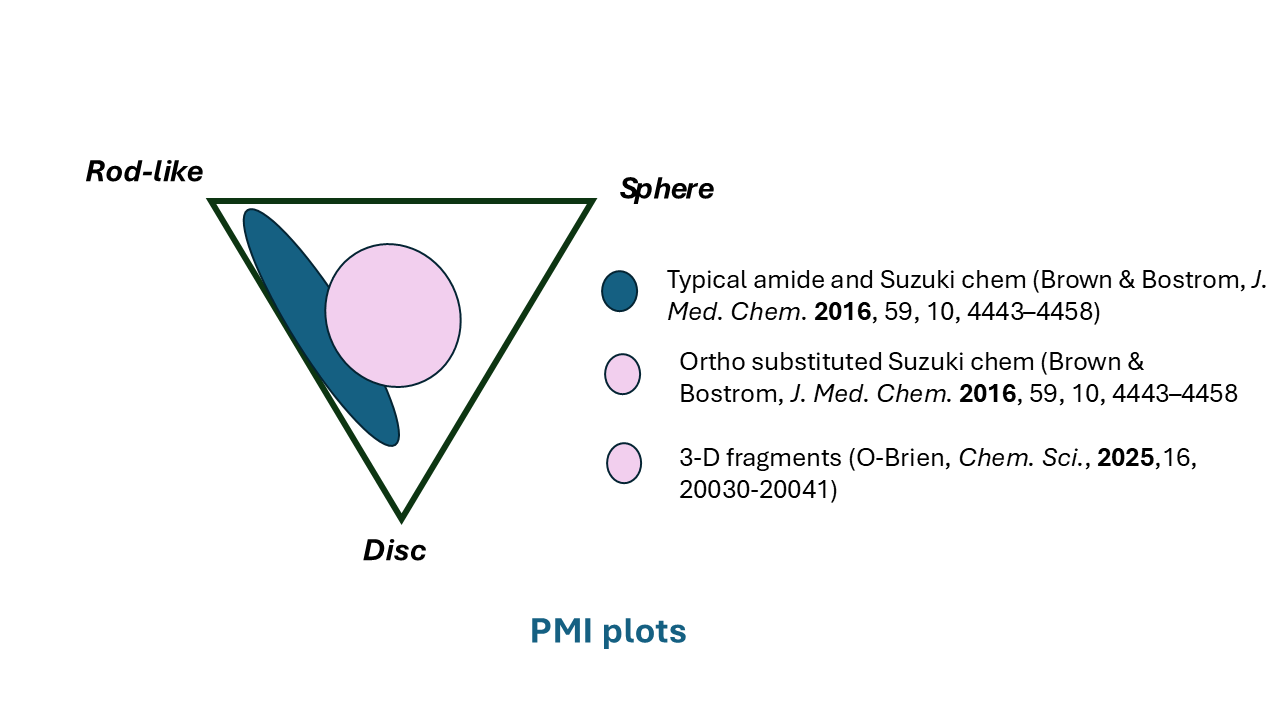
This paper by Peter O’Brien at University of York, and a consortium of other industrial authors describes an effort to design and make a set of shape-diverse fragments. The argument made by the authors is that more 3-D like fragments may cover unique pharmacophoric and chemical space, and perhaps increase solubility compared to fragments rich in sp2 content. The team used principal moments of inertia (PMI) plots to have gauge the 3-D shape. The design strategy limited the number of compounds in the “rod-disc” space and populated a wider breadth using this metric. For comparison, the reader is referred to a manuscript in 2016 by Jonas Bostrom and I where we illustrated how typical chemistries (eg. Amide, Suzuki, etc) over-populate the rod-disc regions. We also illustrated that there were other ways of populating more diverse space, even if these heavily used reactions are employed, such as incorporating more ortho-substituted aromatics using these heavily used reactions.

Some of my own personal reflections here, but I think chemists are attracted to complex and tiny saturated rings like moths to a flame (and perhaps I am one of those). Why is that?
- They look super cool and they are fun to draw
- They are hard to make and chemists like challenges
- They may provide chemical novelty, over the more popular flat and planar fragments.
Kidding aside, here’s the real question…what scientific impact do they have? It’s not an easy question to answer honestly. In an ideal experiment, one would take ~2000 flat planar fragments and ~2000 sp3 rich fragments and screen a diverse set of projects side-by-side, and then compare metrics. But what metrics? What would you measure to say one set is better than the other? Hit-rate? Personally, I think hit-rate may be a misleading metric. I would prefer lower hit rates, but higher quality hits. But what’s a high quality hit? This will vary from chemist to chemist. Perhaps one definitive conclusion would be if one set resulted in hits for “hard-to-drug” targets, and the other set did not. But would it be the sp3 rich set? It’s a theoretical experiment at this point of course, and I would love to see it done….but it’s an expensive one. Perhaps some company with the resources and ambition will give it a try, or perhaps they already have and we won’t know the results for quite a while if they were really compelling.

Comments are closed