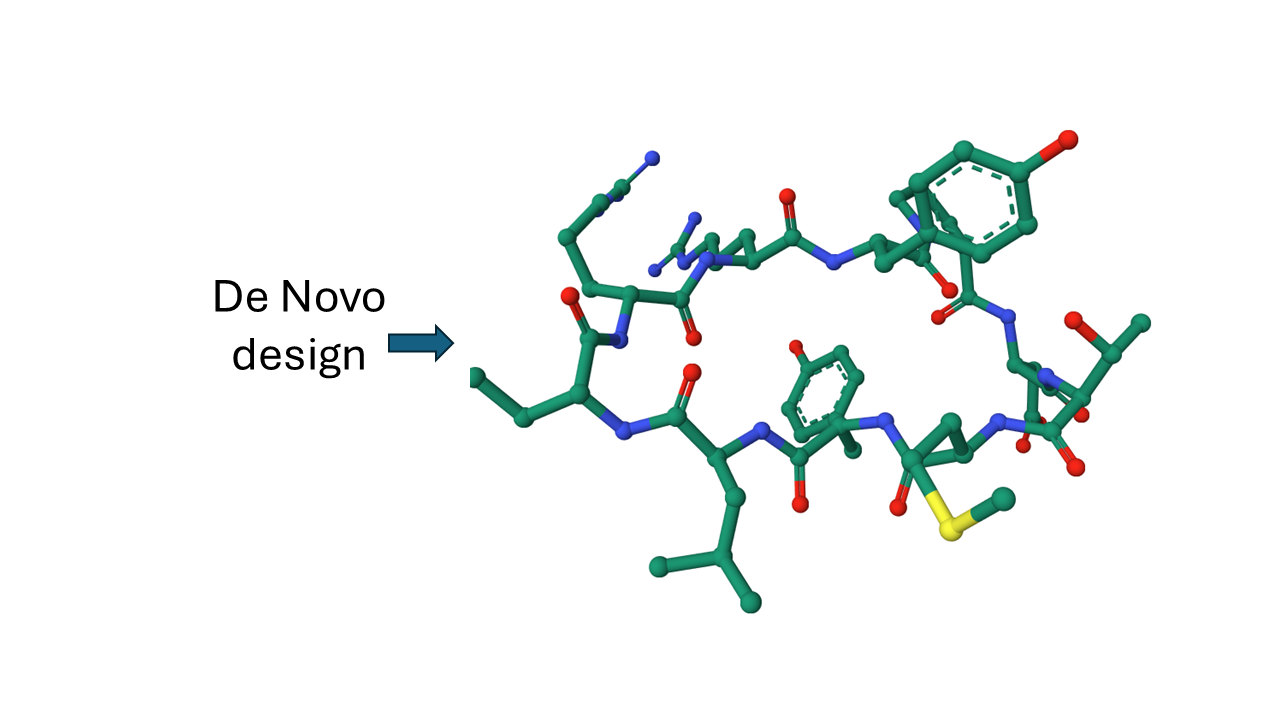
If there is one area that would benefit tremendously from de novo design tools, it is in my opinion macrocycle design. Many frustrated chemists have employed their best ideas, skill and know-how to try and close a ring, and failed. It is my guess, based on my experience and even in my own hands, that there are many more failures at this than success. But, why is it so hard to design? I believe there are at least two interconnected reasons for this. The first is that you are aiming optimize ligand-protein interactions for the portion of the macrocycle that binds. Medicinal chemists do this all the time, so what’s so hard? Well, the second challenge is now that you have and idea of what can bind well, you have to close the rest of the ring and subseqeuntly get all the geometries, ring-strain and potential interference with the ring portion just-right. Off by a few angstroms? Nice try, try again. In addition, changes to the macrocycle linker piece will also result in changes in ligand-protein binding area as the whole molecule tries to relieve ring-strain, or adopt new H-bond interactions.

The other approach to identifying macrocycles is of course using a platform such as phage-display libraries and relying on random luck and sheer numbers. Such approaches obviously require having the technology to screen. However, several successful drugs have been launched with this technology.
What if you could design these de novo, and in effect, sample the vast chemical space in silico that and only make the ones that had a high probability of success to work? One could take a lot of the guesswork out of the good-old-fashioned methods that most medicinal chemists use.
With that context in mind, this in Nature Chemical Biology is quite appealing. Through a collaborative effort by University of Washington, University of College Cork, Tufts University, Heinrich-Heine University, Forschungszentrum Julich and Howard Hughs Medical Institute this paper highlights advances in this area. This work includes as a co-author, David Baker, a recent chemistry Nobel prize winner for his work on predicting protein structure.
The authors adapted two models, RoseTTAFold2 (RF2) structure prediction network and the RFdiffusion protein backbone generation framework to tackle this problem. This was followed by a narrowing of ideas using calculated binding affinity (ddG), spatial aggregation propensity (SAP) and molecular surface area of the interface contacts (CMS)
They presented four targets using this technology:
MCL1, best binder = 2 uM. This was derived from 9,965 diverse cyclic peptide backbones, with four iterations of ProteinMPNN and Rosetta Relax to design four amino acid sequences for each generated backbone.
MDM2, best binder = 1.9 µM. This was derived from~ 10,000 backbones and then the top 11 top-ranked designs by ddG for biochemical and biophysical characterization.
GABARAP (γ-aminobutyric acid type A receptor-associated).Best binders were 0.7 nM and 2.5 nM in the AlphaScreen assay.
Rhombotarget A (RbtA, surface protein from the ESKAPE pathogen, Acinetobacter baumannii). Best binder was Kd = 9.4 nM. Impressively, this was done without protein structure. They used AF2 and RF2 to predict extracellular domains and narrowed from a larger set of macrocyles to 26 designs for biochemical and structural characterization.
As expected, the authors note that they will extend to noncanonical amino acids and novel crosslinkers and cyclization chemistries.

Comments are closed